
The 10 Best Patient Acquisition Strategies: Improving LTV, ROI & Cash Flow Stability
In modern healthcare, patient acquisition strategies are not just a marketing concern they are a financial engine.
For banks and financial institutions that lend to or invest in hospitals, clinics, and medical groups, patient acquisition affects:
- Cash flow management
- Loan repayment capacity
- Lifetime value (LTV) per patient
- Risk and credit underwriting
- Valuation in mergers and acquisitions
A clinic with a predictable, efficient patient acquisition system is, from a banker’s perspective, much closer to a well-managed portfolio of recurring cash flows than a one-off, high-risk operation.
This article explores the top 10 patient acquisition strategies and connects them to finance, LTV, and cash flow management so they make sense not only to healthcare executives, but also to banking and corporate finance teams.
What Is Patient Acquisition?
Patient acquisition is the process of turning members of a target population into new patients who book and attend their first appointment.
From a financial perspective, each acquired patient represents:
- A stream of future cash flows (consultations, procedures, tests, follow-ups)
- A lifetime value (LTV) that can be estimated and modeled
- A cost of acquisition (CAC), similar to customer acquisition cost in banking or retail
Clinics with strong patient acquisition strategies are not only “busier”; they are more bankable because their future revenues are less volatile and more predictable.
What Is New Patient Acquisition?
New patient acquisition focuses on patients who have never used the clinic’s services before.
In financial terms, this is equivalent to:
- Acquiring a new client in private banking
- Opening a new current account or loan relationship
New patients are crucial for:
- Offseting churn and attrition
- Launching new locations or service lines
- Supporting growth projections used in loan applications and M&A valuations
Well-structured patient acquisition strategies allow providers to forecast new patient inflows, similar to how banks forecast new account openings or loan originations.
Why Your Largest Market Traffic Does Not Equal Patient Acquisition
A classic mistake in healthcare marketing is assuming that the largest traffic source = best patient acquisition channel.
However, “Why would your largest market traffic not equal patient acquisition?” has a very simple answer, especially if you think like a banker:
- Traffic is a vanity metric. It’s like raw inquiries at a bank branch — meaningful only if they convert to funded accounts or loans.
- Many visits are low-intent or out-of-area, so they never become patients.
- Without tracking, you can’t link traffic to booked appointments and revenue.
From a financial standpoint, traffic without conversion is analogous to a bank generating thousands of loan leads that never pass underwriting. It consumes cost but does not produce cash flows.
How Digital Marketing Supports Modern Patient Acquisition in 2026
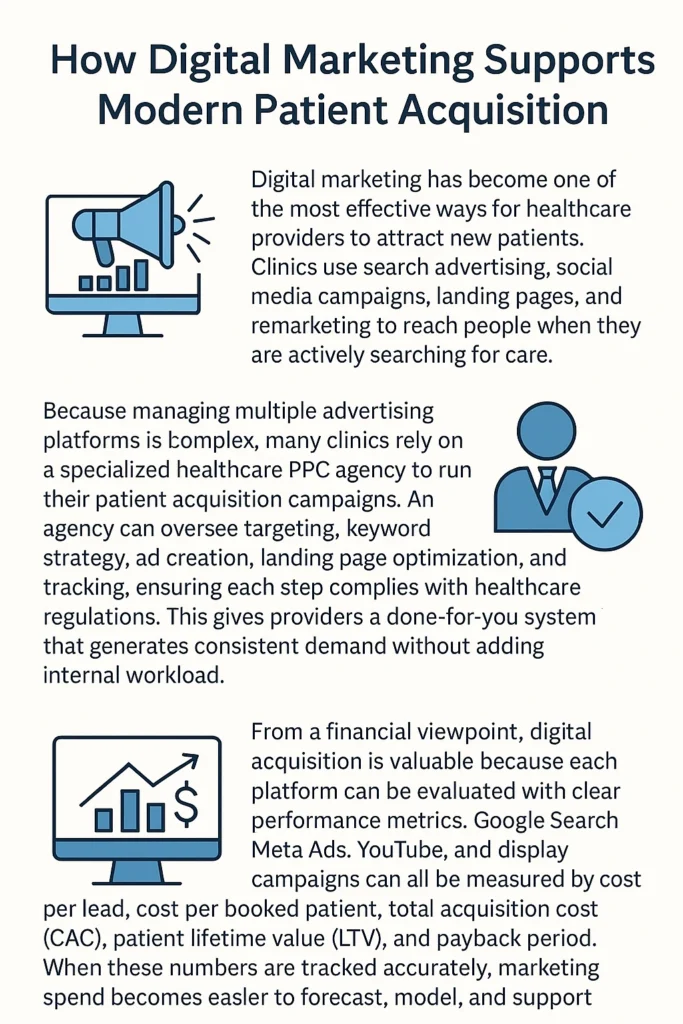
Digital marketing has become one of the most effective ways for healthcare providers to attract new patients. Clinics use search advertising, social media campaigns, landing pages, and remarketing to reach people when they are actively searching for care. These channels help turn online demand into booked appointments in a measurable, reliable way.
Because managing multiple advertising platforms is complex, many clinics rely on a specialized healthcare marketing agency to run their patient acquisition campaigns. An agency can oversee targeting, keyword strategy, ad creation, landing page optimization, and tracking, ensuring each step complies with healthcare regulations. This gives providers a done-for-you system that generates consistent demand without adding internal workload.
From a financial viewpoint, digital acquisition is valuable because each platform can be evaluated with clear performance metrics. Search Engine Marketing (PPC), Meta Ads, YouTube Ads, and Tik Tok campaigns can all be measured by cost per lead, cost per booked patient, total acquisition cost (CAC), patient lifetime value (LTV), and payback period. When these numbers are tracked accurately, marketing spend becomes easier to forecast, model, and support as part of long-term cash flow planning.

Top 10 Patient Acquisition Strategies (With a Finance Mindset)
Below are the top 10 patient acquisition strategies, framed in a way that healthcare leaders, CFOs, and banking partners can all understand.
1. Use High-Intent, Local Targeting Instead of Just High Volume
High-volume keywords and broad awareness campaigns can look impressive, but the best patient acquisition strategies focus on:
- Local, service-specific searches (e.g., “sleep study in [city]”, “IVF clinic [city]”)
- High-intent queries where patients are ready to book
This is similar to a bank preferring qualified loan applications over thousands of generic inquiries.
Financial impact:
Higher conversion rates → Lower CAC → Better unit economics and higher margins per patient.
2. Build Dedicated Landing Pages for Patient Acquisition
“How healthcare providers use landing pages for patient acquisition” is a key question — and a major lever in performance.
Instead of sending all traffic to a generic homepage, leading clinics build dedicated landing pages for:
- Veterinarians
- IVF Fertility treatments
- Chiropractors
- Mental health
- Senior living, etc.
Effective landing pages:
- Align precisely with patient search intent
- Make it extremely easy to call, book, or submit a form
- Use testimonials and accreditations as trust collateral
From a banking lens, landing pages function like a well-designed onboarding flow in digital banking: fewer drop-offs, more funded relationships, more predictable revenue.
Track Patient Acquisition From Digital Campaigns Like a P&L
Many providers still struggle to answer, “How to track patient acquisition from digital campaigns?” or “How do clinics track patient acquisition from digital campaigns?” The solution is to treat marketing as a financial workflow, not a creative one. Effective tracking systems create a direct link between digital activity and real patient outcomes.
The process begins by defining the specific events that count as new patient acquisition. These include a first phone call, an online booking, or a completed form that leads to an appointment. When these events are clearly defined, paid media campaigns become a measurable engine for patient acquisition because they generate structured data that shows where each patient originates and how each channel performs.
Clinics then apply the right tracking tools. UTM tags identify traffic sources, call tracking numbers tie phone leads to specific channels, and analytics events record every booking. Together, these tracking tools reveal which channels produce profitable patient volume, forming a measurable path from marketing spend to appointment revenue.
Once the data is flowing, CAC and LTV become the core metrics. CAC is calculated by dividing total marketing spend by the number of new patients acquired. LTV is measured by multiplying average patient revenue by expected retention. With these numbers, paid media campaigns directly support financial modeling by showing how each dollar invested converts into long-term cash flow, mirroring the way banks evaluate customer acquisition cost and lifetime value in their own portfolios.
4. Manage Patient Acquisition Like a Cash Flow Investment
From a financial perspective, patient acquisition is an investment in future cash flows.
The key metrics are:
- Patient Acquisition Cost (PAC / CAC)
- Patient LTV
- Payback period: how long until one patient’s revenue covers their acquisition cost
- LTV:CAC ratio – ideally 3:1 or better in many industries
Banks evaluating a healthcare borrower should ask:
- Are patient acquisition strategies efficient and measurable?
- Do LTV and CAC support the clinic’s loan repayment plans?
- Is growth driven by sustainable acquisition or one-off events?
For healthcare executives, this framing turns marketing from “budget” into capital allocation.
5. Treat Branding as an Intangible Asset That Lowers CAC
“How branding affects patient acquisition for clinics” is often underestimated.
A strong healthcare brand:
- Increases click-through rates
- Improves conversion rates on landing pages
- Reduces perceived risk for patients (and for lenders)
In accounting terms, branding behaves like goodwill or an intangible asset: it doesn’t show up as a physical asset, but it reduces friction and lowers the cost of acquiring and retaining patients.
For banks, a recognizable, trusted brand in a local market suggests:
- Stronger revenue resilience
- Lower volatility in patient volume
- Better defense against new competition
6. Reduce Patient Acquisition Costs Through Optimization, Not Cuts
Another common question is: “How medical practices can reduce patient acquisition costs?”
Financially, this is not simply about spending less. It’s about increasing efficiency:
- Improve website speed and mobile usability
- Tighten keyword targeting to high-intent searches
- Use landing pages instead of sending traffic to generic pages
- Train staff to handle leads effectively
- Use remarketing to convert undecided visitors
Think of it like a bank reducing cost-per-funded-account by optimizing onboarding—not by closing branches and cutting essential services.
When acquisition becomes more efficient:
- CAC falls
- Margins improve
- Free cash flow increases, strengthening the organization’s credit profile
7. Build Robust Front-Desk and Intake Processes
The front desk is where marketing meets operations.
Even the best patient acquisition strategies fail if:
- Calls go unanswered
- Forms don’t receive a quick follow-up
- Staff cannot answer basic questions about insurance, pricing, or availability
Operationally, this is similar to a bank’s ability to:
- Process loan applications
- Respond to inquiries
- Onboard new clients efficiently
From a finance perspective, the front desk is where modeled LTV either becomes a real cash flow or evaporates.
8. Use Education-Driven Content as a Lead Quality Filter
High-quality educational content addresses questions like:
- “What is patient acquisition?”
- “What is new patient acquisition?”
- “How medical practices can reduce patient acquisition costs?”
- “Why would your largest market traffic not equal patient acquisition?”
This type of content:
- Attracts informed, high-intent patients
- Positions the clinic as an expert (similar to thought leadership in banking)
- Increases trust and improves conversion rates for higher-value procedures
For financial partners, a provider with strong content and patient education often has better retention and higher LTV, because patients feel guided rather than sold to.
9. Apply Segmentation and Lifetime Value Thinking to Service Lines
Different service lines have different LTV profiles:
- A one-off imaging test
- vs. a long-term chronic care pathway
- vs. an elective high-ticket procedure
Smart patient acquisition strategies:
- Match acquisition budget to expected LTV per patient segment
- Push harder on high-LTV services where CAC can be higher but still profitable
- Use low-margin services as lead sources for longer-term care relationships
This mirrors how a bank balances:
- Low-margin, mass-market products
- High-margin, relationship-based services
- Cross-sell and upsell opportunities across a client’s lifecycle
10. Integrate Patient Acquisition With M&A and Strategic Growth
In a consolidating healthcare landscape, it’s natural to ask:
“How do healthcare mergers and acquisitions impact patients?” and
“What are the potential benefits for patients with this acquisition?”
From a patient acquisition perspective, M&A can:
- Expand geographic reach
- Integrate referral networks
- Combine marketing and data systems
- Enhance brand strength
For patients, potential benefits include:
- More accessible locations
- Broader service offerings
- Improved continuity of care
For banks and investors, a healthcare group with integrated, measurable patient acquisition strategies across merged entities has:
- Stronger economies of scale
- More predictable cash flow
- Enhanced creditworthiness and growth potential
Quick Read: Digital Transformation in Oman’s Banking Sector
Example: Can Sleep Study Acquisition Be Available for Patients Efficiently.
The search query “can sleep study acquisition be available for patients” reflects a practical question:
Can we make it easy and affordable for patients to access sleep studies?
From a patient acquisition and finance angle:
- Dedicated sleep study landing pages + clear CTAs → more bookings
- Transparent pricing and insurance information → fewer drop-offs
- Efficient scheduling and follow-up → higher completion rates
For a lender evaluating a sleep center, an efficient sleep study acquisition pathway translates into:
- More consistent volume
- Smoother cash flow
- Stronger repayment capacity
FAQ: Key Patient Acquisition Questions Answered
What is patient acquisition?
Patient acquisition is the set of strategies and processes that turn potential patients into first-time, active patients who book and attend an appointment. In finance terms, it’s the origination phase of a long-term revenue relationship.
What is new patient acquisition?
New patient acquisition refers only to patients who have never been seen before. These patients drive net growth and form the basis for projecting future LTV and cash flows.
How to track patient acquisition from digital campaigns?
Track patient acquisition by:
- Using UTMs and call tracking for each campaign
- Defining “acquisition events” (new patient bookings, first calls)
- Connecting call logs, online bookings, and forms to analytics
- Calculating CAC and LTV per channel
This turns marketing into a measurable investment decision, comparable to how banks track cost per funded account.
Why would your largest market traffic not equal patient acquisition?
Because traffic is not the same as qualified demand. Large traffic may come from the wrong geography, wrong stage of the journey, or unqualified users, and may produce very few real patients. It’s the conversion into appointments that matters.
How healthcare providers use landing pages for patient acquisition?
Providers use focused, service-specific landing pages to:
- Match patient intent
- Highlight benefits, credentials, and trust signals
- Offer simple, clear calls-to-action
This reduces friction and significantly improves conversion, lowering acquisition cost per patient.
How branding affects patient acquisition for clinics?
Branding creates trust. A strong brand improves click-through rates, conversion rates, and patient loyalty. Financially, branding behaves like an intangible asset that makes each euro or dollar spent on acquisition more efficient.
How medical practices can reduce patient acquisition costs?
By:
- Improving targeting
- Optimizing landing pages
- Strengthening front-desk follow-up
- Using remarketing
- Measuring CAC and LTV and reallocating budget accordingly
The goal is to increase efficiency, not just reduce spend.
Conclusion: Patient Acquisition Strategies as a Financial Discipline
For healthcare providers, patient acquisition strategies are no longer a pure marketing topic — they are a core financial discipline:
- They shape LTV, CAC, and payback periods
- They drive cash flow stability and growth
- They influence how banks and investors evaluate risk and creditworthiness
For banks and healthcare organizations alike, the question is not just “How do we get more patients?” but:
“How do we design, measure, and finance patient acquisition strategies that produce sustainable, predictable cash flows over the long term?”
That is where healthcare operations, marketing, and banking priorities fully align.